|
CLICK TO RETURN TO
ALPHABETICAL PRODUCT INDEX ON HOME PAGE
|
View Shopping Cart
SHOFAR - Questions Often Asked About Shofars
The Shofar Man
answers questions about the ancient Jewish Shofar, Shofar
blowing, Yemenite Shofar, rams horn Shofar, how to buy a Shofar horn,
types of Shofar sounds that a typical Judaica Shofar will make,
different types of Shofar for sale, how to buy Shofar, different Shofar
sounds, Shofar cleaning, my shofar is hard to play, shofar how to, kudu
horn, what to look for in a Shofar
sale and much much more.
1. "What type of animal does the Yemenite Shofar come from?"
(The Yemenite
Shofar) comes
from an African Kudu. We believe a picture is worth a thousand words.
In the background of the picture below of The Shofar Man, you will see
an African Kudu. This animal weighs in at over 750lbs.

2. "What
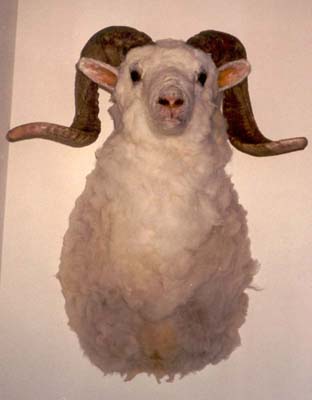
type of animal do the smaller, curved Shofars come from?"
(These Shofars)
sometimes called Rams Horn Shofar come from a sheep, goat, or mountain goat, but
they most often come from a ram as pictured below, thus the common name of Rams
Horn Shofar.
3. "How
should I store my Shofar?"
(Per the
manufacturer, a Shofar) should never
be stored in plastic, in a bag, or in a confined area for any length of time.
The Shofar should be kept out in the open air. Shofars kept sealed up in a
dark, enclosed place tend to deteriorate. Animal horns like wood are a sort of
living product and need to be carefully cared for.
They need to be regularly dried out on any
sounding, especially any sounding going on over 15 minutes or more. At 15 minute
intervals they should be blown out with some kind of dry compressed air, usually
in a can. Also when playing and putting them down in a service, they should be
rested on a stand or held with the mouthpiece in an upward position. Human
spittle is a killer of instruments because of moisture and enzymes. So always
use canned air to blow out a Shofar after each use.
4.
The Shofar Man teaches in conferences around the world, and two questions that
come up at almost every conference are,
"Why do Shofars have an offensive
odor?" and,
"What can I do about it?"
Keep in mind that the people that ask these Shofar questions are from all over
the world and have bought their Shofars from many different distributors,
dealers, and manufacturers.
After hearing these questions so many times and personally testing and
inspecting hundreds of Shofars from all over the world produced by the best
Shofar manufacturers of Jewish Kosher Shofars, I have come to the conclusion
that all Shofars have an odor to them and it is just the nature of A Shofar.
We must remember we are dealing with a horn off of an animal. This Shofar horn
is full of flesh and blood before it is made into an instrument of praise,
worship, and warfare called a Shofar.
Over the years, I have heard and tried many methods of removing the smell of the
Shofar. Here are a few: 1 - Vinegar & Water, 2 - Alcohol & Water, 3 - Chlorine
& Water, 4 - Borax Soap, 5 - Different Soaps, 6 - Odor Eliminators, 7 - Filling
the Shofar with light gravel & shaking it back and forth to loosen the decaying
flesh.
After trying many solutions, I have found one that by far exceeds the result of
the others. That solution is to seal the smell by applying a sealant to
the inside of the Shofar. This is very easy to do and on request the Shofar Man
will explain to you exactly how to do this. It will reduce the smell but may not eliminate it
completely.
Warning! After years of experience, I can tell you that when purchasing a
Shofar, if you are told that the Shofar will have no smell or odor, then you are
not getting a genuine Jewish Kosher Shofar!
There are man-made synthetic or plastic Shofars that do not smell, but they are
not G-d's creation. They are man's Shofars.
|
5. "Are Shofars with
splits or cracks considered unfit or bad?"
It is
very common to have splits or stress cracks near the Shofar
mouthpiece end caused during the heating process. The
Shofar Man's personal Shofar has four splits on the
mouthpiece end that run up to 6" up the Shofar. The
Shofar plays and sounds fantastic. According to the
two largest Shofar manufacturers in Israel, these types of
cracks will never affect the Shofars sound or quality of the
Shofar, as long as they are dried out after each use.
The other area splits or cracks can occur in a Shofar is in
the Shofars bell end or large end of a Shofar. Again, both
manufacturers say these splits will not affect the Shofars
sound or quality of the instrument.
In both of the above cases, the Shofar is not considered to
be a damaged Shofar but it is the nature of this natural
product. |
|
6. "Can Shofars be broken?"
Yes! The
Shofar Man has broken his personal Shofar on a couple of occasions. Shofars are
pretty durable, but if you hit a Shofar hard enough or drop a Shofar on a
concrete floor, the Shofar could crack.
7.
"Can a broken Shofar be fixed?"
Sometimes you can fix a Shofar by putting
a little super glue on the inside of the crack. Other times, you can shorten
the Shofar a little and cut out the broken section. We only recommend
shortening the Shofar if there is a section broken out that affects the looks.
We would not shorten a Shofar because of a split.
8.
"Why are some Shofars more yellow near the mouthpiece than others?"
The larger the Shofar, the more it must be
heated during the manufacturing process. It is common for bigger Shofars to be
more yellow on the mouthpiece end of the Shofar.
Shofars made in Israel are torched usually with a rosebud, and heated to about
350 degrees F; this causes steaming and microfractures. With the microfractures
there is a stress affect that tends to open small fissures along the
developmental lines of the animal's horn. Thus the stress marks and cracks are
common to all Shofars, especially from the mouth piece up the Shofar about 6
inches or so.
All Shofars have some type of what a person might call an "imperfection."
Especially if compared to a man-made or assembly-line product. All Shofars have
dings, dents, marks, etc. The hole in a Shofar mouth piece is often driller off
center a little to the left or right. Very very rarely will the hole in a Shofar
mouth piece be in the center. Remember these are not a machine made product but
a natural product. A Shofar is a horn from a wild animal, and these horns take
a beating. The animal will hit its horns on objects and even fight with them.
You will normally have less dings and dents with a fully polished Shofar. You
will normally have less noticeable cracks with a completely natural Shofar, but
dings and dents will be more visible because it looks just as it did before it
came off the animal.
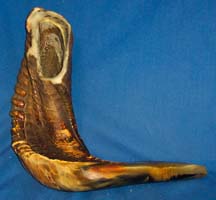
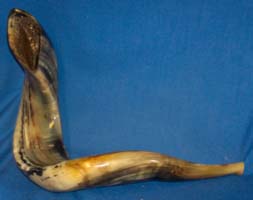
9. "What is an 'Easy Blow' Rams Horn Shofar?"
According to
our manufacturer out of Israel, rams horns shofars are normally straightened on
the end to give the shofar horn a very long, slender, elegant shape (as shown in
the shofar pictured on the right, below) with a slight widening or flaring out
at the mouthpiece of the shofar. Sometimes rams horns break during this
process, and they must be cut off where the shofar horn is wider. When this
happens, the broken shofar is saved by drilling it out and forming a wider
mouthpiece. Sometimes these wider shofar mouthpieces are easier to play, but
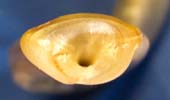
when you look at the shofars from the mouthpiece end, they lose some of their
beauty (as shown in the shofar pictured on the left, below). Because the shofar
has no flare to them, they are just cut straight off. A traditional shofar
mouthpiece flares out, giving it a natural beauty.
|
10. "What is an 'Easy
Play' Rams Horn Shofar?"
An "Easy
Play" Rams Horn shofar is not cut off or shortened in any
way. It keeps its long, slender elegant shofar look. The
shofar mouthpiece is ground out to its widest possible
point, making the shofar easier to play without destroying
the shofar looks.
11.
"What is an 'Easy Blow' Yemenite Shofar?"
It is a Yemenite
Shofar that has a bigger shofar mouthpiece than a
traditional yemenite shofar mouthpiece. It is easier to
play because there is more room for your lips in the shofar
mouth piece.
12.
"Is a bigger Shofar mouthpiece better for everyone?"
If you blow the
Yemenite Shofar from the front, the bigger shofar
mouthpieces are always easier. If you blow a shofar in the
traditional way, from the corner of the mouth, then a
traditional smaller shofar mouthpiece is usually better.
13.
"Does an Easy Blow Shofar or Custom ShofarMouthpiece on a
yemenite Shofar take away from its looks?"
No! Unlike the rams
horn shofar, its natural shape does not flare out at the
mouthpiece, so the Shofar looks just like a traditional
Yemenite Shofar even though the Shofar has been modified. A
custom Shofar or wider Shofar mouthpiece on a Yemenite
Shofar not only is easier to play, but it sounds better and
looks great too.
14.
"The mouthpiece on my Yemenite Shofar is too small; can it
be widened?"
The Shofar Man has
people send him Shofars all the time from all over the world
to modify or widen the Shofar mouthpieces for them. Many
people that could not get a sound out of their Shofars can
play them wonderfully after the Shofa has been widened. The
Shofar Man has also shown many people how to modify the
mouthpiece of their own shofar. |
|
|
15.
"Are 'Easy Blow Shofars' better for children?"
Not really. A child
can pick up the smallest of Shofars and get a good Shofar
sound from it, when an adult can't get a sound. Children
have smaller lips and therefore can play even the smallest
of Shofars.
16. "Is there a
difference between Shofar mouthpiece customization and
widening a mouthpiece?"
Yes.
Widening a Shofar mouthpiece is accomplished by grinding out
the existing Shofar mouthpiece to its widest possible point
without actually cutting or reshaping the Shofar mouthpiece.
Shofar Mouthpiece customization requires the shortening of
the Shofar by about one inch, then regrinding the Shofar
mouthpiece and shaping it like the inside of a mouthpiece on
a brass trumpet. It is bowled out to give plenty of space
for the lips to fit completely in the Shofar mouthpiece.
17.
"What is a scentless shofar?"
(According to the two
largest Shofar)
manufacturers in Israel, there is no such thing as a
scentless or odorless Shofar when left in its natural
state. The only way that we have found to help reduce the
smell is to seal the inside of the Shofar. (Please refer
back to Question #4 on this page for more details.)
If you
have a Shofar question that is not answered on this page
Click Here + Email Your Shofar Question.
|
|
|
|