|
CLICK TO RETURN TO
ALPHABETICAL PRODUCT INDEX ON HOME PAGE
|
Wedding Chuppah
from $167.77 -
Chuppah Tallit - Wedding Tallit - Huppah - Huppa
Fast USA Shipping!
The Shofar Man is your source for wedding chuppah, wedding huppah, wedding
huppa, chuppah, huppah, huppa, chuppah tallit, huppah tallit, huppa tallit.
|
Our Lowest Priced Chuppah
The Bridal Canopy Chuppah
$167.77
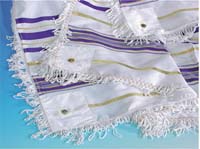
93" X 70" Chuppah
with
Grommets on the corners
(NO POLES INCLUDED)
#HP1
|
|
Huge 70 x 80 White /Silver / Gold Wool Chuppah Tallit
A Favorite for
Weddings!
Gabrieli chuppah tallits are not machine made. Each tallit is
hand woven on an old world loom. Because every tallit is hand made
by a different weaver, patterns can vary from tallit to tallit. In
general, tallits will look very close to the pictures with some
pattern variation.
This
artistic, hand woven, wool chuppah comes as a 3 piece tallit set
including - talit, kippah and talis bag.
This
is by far our Highest Quality Chuppah Tallit!
$490.00 - #HP3
|
|
Our Best Quality Chuppah
80" X 80"
Pomegranates Huppah by Emanuel
$567.99
#HP2 |
***OUT OF STOCK***
"Samach Tesamach
Reaim Hahuvim Kesamach Yetzircha Began Eden Mikedem"
|
For Additional Large Tallits that can
be used as a Chuppah - Click Here
For Several Hand Woven Extra Large
50" X 80" Tallits by Israel's Gabrieli Family - Click Here
History of Chuppah
The word chuppah originally appears in the Hebrew Bible (Joel 2:16; Psalms
19:5). The chuppah represents a Jewish home symbolized by the cloth canopy
and the four poles. Just as a chuppah is open on all four sides, so was the
tent of Abraham open for hospitality. Thus, the chuppah represents
hospitality to one's guests. This "home" initially lacks furniture as a
reminder that the basis of a Jewish home is the people within it, not the
possessions. Historically, in Talmudic times, Jewish weddings comprised two
separate parts, the betrothal ceremony and the actual wedding ceremony.
These two ceremonies usually took place about a year apart. The bride lived
with her parents until the actual marriage ceremony, which would take place
in a room or tent that the groom had set up for her. Later in history, the
two ceremonies were combined and the marriage ceremony started to be
performed publicly. At this new ceremony, the chuppah, or the portable
marriage canopy, was included as a symbol of the chamber within which
marriages originally took place.
Symbolism
In a spiritual sense, the covering of the chuppah represents the presence of
God over the covenant of marriage. As the kipa served as a reminder of the
Creator above all, (also a symbol of separation from God), so the chuppah
was erected to signify that the ceremony and institution of marriage has
divine origins.[citation needed]. The "chuppah" may also represent the home
of Abraham and serve as a reminder that he was a foreigner in a strange
land, looking for the place God had promised to him. Before going under the
chuppah the groom covers the bride's face with a veil, known as the badeken
(in Yiddish). The origin of this tradition is in the dispute of what exactly
is the chuppah. There are opinions that the chuppah means covering the
bride's face, and that by this covering the couple is to be married. Thus,
some insist that the marriage witnesses also see this act of covering, as it
is a formal part of the wedding. The groom enters the chuppah first to
represent his ownership of the home on behalf of the couple. When the bride
then enters the chuppah it is as though the groom is providing her with
shelter or clothing, and he thus publicly demonstrates his new
responsibilities toward her. From Wikipedia, the free encyclopedia
|

.jpg)
.jpg)
.jpg)
.jpg)